
Maria Tallchief as Firebird in Firebird. Source: The New York Public Library.
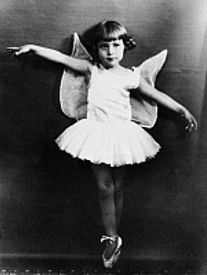
Young Maria Tallchief. Source: Granger Academic.

Maria Tallchief as Odette in Swan Lake. Source: The New York Public Library.

The Five Moons, from left to right: Maria Tallchief, Marjorie Tallchief, Rosella Hightower, Moscelyne Larkin, Myra Yvonne Chouteau. Source: OU School of Dance.
The Firebird’s Spark: Remembering Maria Tallchief
By Annabel Long, Ballet Company at UCLA
January 24, 2026
Maria Tallchief was a professional ballerina and later an artistic director, and many
people consider her to be the United States’ first prima ballerina. As a member of the Osage Nation, she broke barriers in ballet. On the 101st anniversary of her birth, we celebrate Ms. Tallchief for her grace, determination, and strength.
Early Life
Maria was born as Ki He Kah Stah Tsa, or Elizabeth “Betty” Marie Tall Chief, on January 24, 1925, on the Osage Nation Reservation in Oklahoma. She had an older brother named Jerry and a younger sister named Marjorie, who was her best friend. Mrs. Tall Chief enrolled both of her daughters in ballet classes after they each turned three, and Betty Marie also started learning piano. In 1933, the Tall Chiefs moved to Los Angeles. Betty Marie continued learning ballet from Ernest Belcher followed by Bronislava Najinska, who was a former Russian ballerina and choreographer.
Unfortunately, Betty Marie’s childhood was marred by the discrimination and violence that many Indigenous Americans faced in the early 20th century. The Osage Nation’s ancestral home includes large areas in present-day Arkansas, Kansas, Missouri, and Oklahoma, but, in a series of forced removals, white colonizers restricted the Osage to unfertile land in Oklahoma. The discovery of oil under the reservation led to the Osage Reign of Terror, in which white men murdered Osage people to steal their oil rights. Between 1921 and 1926, over 60 Osage people were murdered, including several of Betty Marie’s relatives. Also, during the early 20th century, the U.S. federal government banned Indigenous Peoples from speaking their languages and holding ceremonies. In Los Angeles, Betty Marie faced microaggressions and blatantly racist comments from her classmates, who mockingly asked her whether her last name was Tall or Chief. This made her feel pressured to change her last name to Tallchief.
Despite these hardships, Betty Marie continued to pursue her dreams of becoming a ballerina. During her teenage years, she danced in shows choreographed by Ada Broadbent, Madame Najinska’s ballets at the Hollywood Bowl, and a musical called Presenting Lily Mars. After graduating from high school, she moved to New York and joined the Ballet Russe de Monte Carlo as an apprentice ballerina.
Ballet Star
After the Ballet Russe de Monte Carlo’s tour in Canada, Betty Marie became a member of the corps de ballet, which is the group of ballerinas who dance together. She was a very talented dancer, and, within a few years, she performed as a soloist. Some people in the Ballet Russe pressured her to change her name to Maria Tallchieva to sound Russian. Although she changed her first name, she honored her heritage by keeping her last name.
In 1944, Ms. Tallchief met choreographer George Balanchine. Recognizing her talent, Mr. Balanchine gave Ms. Tallchief feedback to improve her technique, and he cast her in solos in his ballets. The two married in 1946, and they briefly worked with the Paris Opera Ballet, making Maria the first American ballerina to dance with the company. After her contract with the Ballet Russe de Monte Carlo ended, Maria joined her husband’s new ballet company: the Balanchine Ballet Society, which has since been renamed New York City Ballet. For nearly 20 years, she danced as the company’s principal, or the ballerina who performs the lead parts. Even after Ms. Tallchief and Mr. Balanchine divorced in 1950, they kept their professional relationship as principal and choreographer.
During her career with the New York City Ballet, Ms. Tallchief gave many remarkable performances. When she danced as the Sugar Plum Fairy in Balanchine’s first rendition of The Nutcracker, one critic described her as “a creature of magic, dancing the seemingly impossible with effortless beauty of movement, electrifying us with her brilliance, enchanting us with her radiance of being.” Maria’s amazing performance helped make this ballet a December tradition in the United States. She also danced lead parts in ballets like Four Temperaments, Orpheus, and Swan Lake. Ms. Tallchief is most famous for dancing as Firebird in Firebird. Through her strong technique and beautiful dancing in this role, she became the United States’ first prima ballerina.
Choreography and Impact
Although Ms. Tallchief retired as a ballerina in 1966, she stayed involved with the ballet world. After the Lyric Opera of Chicago hired her to teach the singers choreography, she became the ballet director there, and she started a ballet school for the opera house. In 1974, Maria founded Chicago City Ballet, and she and her sister Marjorie co-founded a ballet school associated with the company. Although Chicago City Ballet disbanded in 1987, it allowed future Chicago-based ballet companies like Joffrey Ballet to succeed. Sadly, on April 11, 2013, Ms. Tallchief passed away.
Maria Tallchief has received much recognition as a brilliant dancer and artistic director. In 1953, the Osage Nation honored her with the title Princess Wa-Txthe-thonba, which means the Woman of Two Worlds. The state of Oklahoma made June 29th Maria Tallchief Day that same year. In 1996, Ms. Tallchief was inducted into the National Women’s Hall of Fame, and she was later inducted into the National Native American Hall of Fame in 2018. Oklahoma also honors her, her sister Marjorie, Moscelyn Larkin, Rosella Hightower, and Myra Yvonne Chouteau as the Five Moons, five famous Indigenous ballerinas from the state.
Not only did Maria Tallchief grace the world with her beautiful dancing, but she disproved stereotypes and made ballet more inclusive. She has changed the ballet world for the better in more ways than one.
Sources
Billy Rose Theatre Division, The New York Public Library. (1966). New York City Ballet - Maria Tallchief in "Firebird", choreography by George Balanchine (New York) [Photograph]. Retrieved from https://digitalcollections.nypl.org/items/658c9dd0-5bcd-0133-1805-00505686d14e
Billy Rose Theatre Division, The New York Public Library. (1966). New York City Ballet - Maria Tallchief in "Swan Lake", choreography by George Balanchine (New York) [Photograph]. Retrieved from https://digitalcollections.nypl.org/items/b3f3d5d0-3f85-0133-d495-00505686d14e
Clinton, C. (with Boiger, A.). (2017). She Persisted (Stantopolo, J., Ed.). Philomel Books.
Marabella, N. (2025, March 24). A Look Back on Maria Tallchief’s Legacy. Newberry Library. https://www.newberry.org/blog/a-look-back-on-maria-tallchiefs-legacy
MARIA TALLCHIEF (1925-2013). Native American ballerina. At age of 3 or 4. Photograph, c1929 [Photograph]. (2021). Granger Academic.
https://www.grangeracademic.com/results.asp?image=0259458&itemw=4&itemf=0004&itemstep=1&itemx=3
National Women’s Hall of Fame. (n.d.). Maria Tallchief. Women of the Hall. https://www.womenofthehall.org/inductee/maria-tallchief/
OU School of Dance. (n.d.). [The Five Moons, from left to right: Maria Tallchief, Marjorie Tallchief, Rosella Hightower, Moscelyne Larkin, Yvonne Chouteau] [Photograph]. https://dance.ou.edu/fivemoonsfest
SAB trailblazer—Maria Tallchief. (2021, March 1). School of American Ballet. https://sab.org/scenes/sab-trailblazer-maria-tallchief/
Tallchief, M., & Kaplan, L. (1997). Maria Tallchief: America’s prima ballerina. Henry Holt.
The Osage Nation. (n.d.). About the Osage Nation Reservation. Osage Culture. https://www.osageculture.com/visitors/about-osage-reservation